Editorial blog
Royal Barge Procession 2026: A Practical Bangkok Guide
Plan for Bangkok's Royal Barge Procession 2026 with verified rehearsal dates, viewing guidance, river restrictions, cultural context and practical cautions.
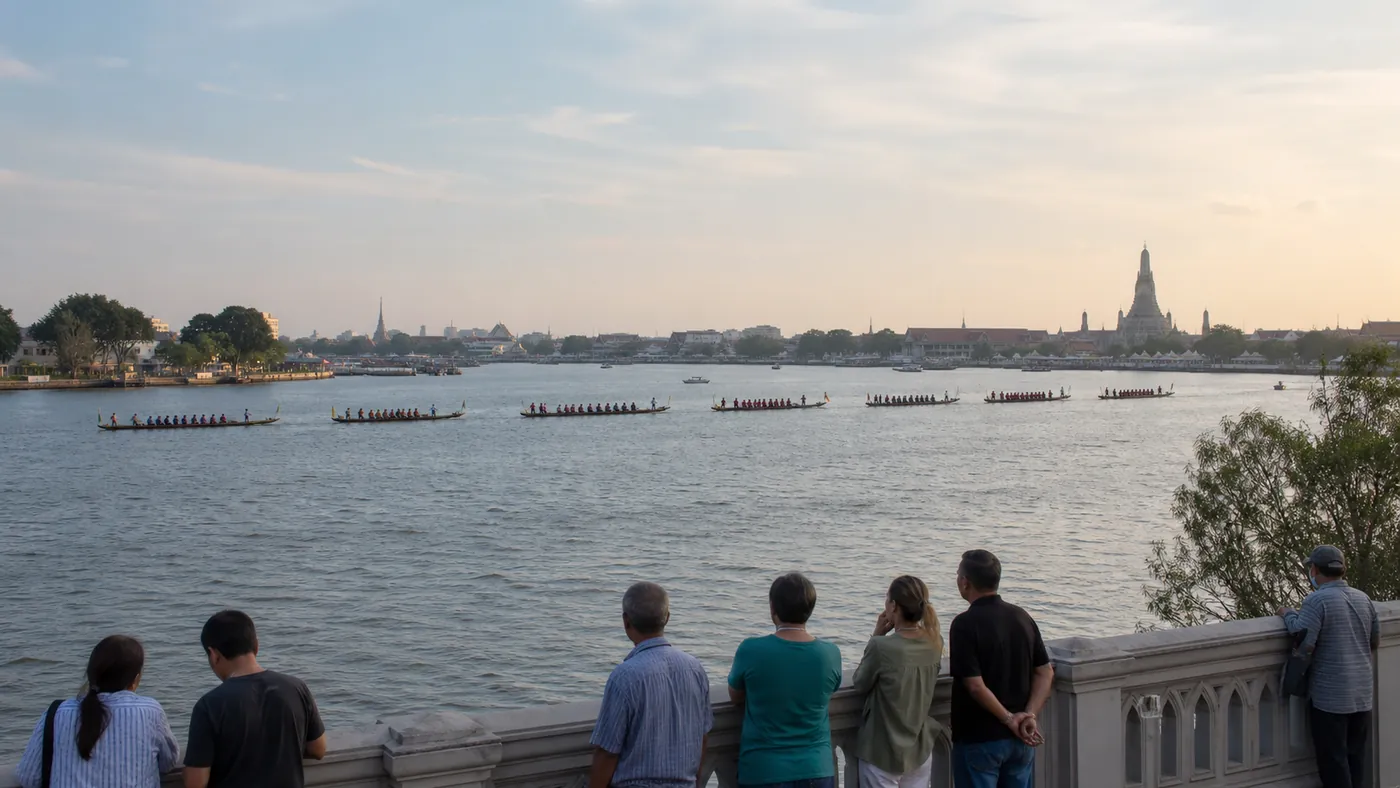
Bangkok's Chao Phraya River is usually read in fragments: a temple prang above the roofs, an express boat cutting across the current, a ferry linking two neighborhoods. Between now and early November 2026, the river will also carry one of Thailand's rarest ceremonial sights. The Royal Thai Navy is rehearsing a 52-barge formation ahead of the Royal Barge Procession and Royal Kathin Ceremony at Wat Arun Ratchawararam on Friday, 6 November.
This is not an event to approach with a fixed itinerary copied months in advance. Rehearsal dates are confirmed, but navigation controls, spectator arrangements and weather can reshape a day on the river. The most useful plan is therefore a verified one: understand the ceremony, choose a date that fits your priorities, build a land-transport alternative and check official notices again shortly before leaving.
What the Royal Barge Procession represents
The procession is not a tourist parade staged on a recurring festival calendar. It forms part of a Royal Kathin Ceremony, the royal observance of the Buddhist tradition in which robes and offerings are presented to monks after Buddhist Lent. In 2026, His Majesty the King is scheduled to travel by water to present Kathin robes at Wat Arun, in connection with celebrations of Her Majesty Queen Suthida's fourth-cycle, or 48th, birthday anniversary.
The Tourism Authority of Thailand's August 14 announcement describes a fleet of 52 royal barges crewed by 2,200 Royal Thai Navy personnel. The formation is planned in five columns and three lines, approximately 1,280 meters long and 90 meters wide. It will depart Wasukri Pier and pass landmarks including Phra Sumen Fort, Somdet Phra Pinklao Bridge, Siriraj Hospital and the Grand Palace before reaching Wat Arun.
Those numbers are useful not because scale alone makes a story, but because they explain the rehearsal program. A formation stretching more than a kilometer depends on coordinated rowing, steering and spacing across a working urban river. Watching a rehearsal can reveal that disciplined preparation without pretending that a practice session and the royal ceremony are interchangeable.
The confirmed 2026 dates still ahead
As of 24 August, two August rehearsals have already taken place. The Government Public Relations Department's full rehearsal schedule lists the remaining minor rehearsals for 27 August; 3, 8, 17 and 23 September; and 2, 8 and 15 October. Two full-dress rehearsals are scheduled for Wednesday, 21 October and Wednesday, 28 October. The Royal Barge Procession and Royal Kathin Ceremony follow on Friday, 6 November.
Official notices say rehearsals are expected to begin at approximately 2:30 p.m. That is a working time, not an invitation to arrive at 2:25. Security arrangements, river controls, crowding and the walk from land transport all require margin. If the event is central to your Bangkok stay, keep the surrounding afternoon flexible and avoid making a tightly timed reservation immediately before or after it.
Minor rehearsals versus full-dress rehearsals
A minor rehearsal offers more dates and may fit a traveler whose priority is seeing the scale, rhythm and route of the formation. A full-dress rehearsal is the stronger choice for someone seeking the closest available preview of ceremonial presentation. Time Out Bangkok's independent August 8 report says full-dress rehearsals are planned with decorated barges and personnel in ceremonial dress. That description is useful independent context, but official instructions on the day should take precedence over any media preview.
The 6 November ceremony has a different significance. It is a royal and religious observance, not simply the most elaborate version of a rehearsal. Travelers should expect a higher level of formality and potentially more demanding access conditions. Choose the ceremony for its meaning, not merely for spectacle; choose a rehearsal if flexibility and observation of the preparation are more important.
Where public viewing is confirmed—and what is not
Official English-language announcements identify viewing areas along both banks of the Chao Phraya between Krung Thon Bridge and Wat Arun Ratchawararam. That is a long corridor, not a promise that every meter of riverfront is publicly accessible or offers an unobstructed view. Private buildings, temple grounds, road layouts, temporary barriers and event operations will determine what is practical on a particular date.
A sensible approach starts with access rather than backdrop. Pick a part of the announced corridor that you can reach by rail, bus, taxi or walking without depending on a ferry that may stop. Then identify a second land-side option on the same bank. Do not assume you will be able to cross the river late in the day, and do not build a plan around entering a hotel terrace, restaurant, temple compound or private pier without confirming its own rules.
The August 14 operational notice relaying Royal Thai Navy information says the public can watch from designated areas between Krung Thon Bridge and Wat Arun and warns that the Navy will issue further information if schedules or spectator arrangements change. For readers who want to understand how the river, canals, temples and neighborhoods fit together before choosing an area, Bangkok for the editorial traveler provides a slower orientation to the city beyond a checklist of landmarks.
River controls can change your entire route
The strongest reason to verify on the day is practical: the Chao Phraya is both the stage and a transport artery. For the August rehearsals on the 17th, 20th and 27th, the Marine Department announced navigation controls from Krung Thon Bridge to Phra Pok Klao Bridge. Its published plan restricted certain commercial vessels from 9 a.m. and called for all vessels to avoid the controlled river section from 12:30 p.m. until rehearsals finished. Bangkok Noi Canal was also closed to vessels from its mouth to Wat Suwannaram from 12:30 p.m.
The August 17 Marine Department notice, published in Thai by the Government Public Relations Department, gives the most specific passenger-service information for those August dates. It states that Chao Phraya Express Boat service would be divided outside the controlled area after 12:30 p.m.; several electric-boat and cross-river services at Wang Lang, Tha Phra Chan, Tha Maharaj, Tha Chang and Wat Rakhang would operate only until 12:30 p.m.; and the Tha Tien ferry would operate until 3 p.m.
Those details support planning for 27 August; they should not be copied automatically onto September, October or November. Later controls may use different boundaries or hours. Treat the latest Marine Department, Royal Thai Navy and TAT notices as the authority, and ask your accommodation to verify current local access if your route depends on a pier.
Build a land-based fallback
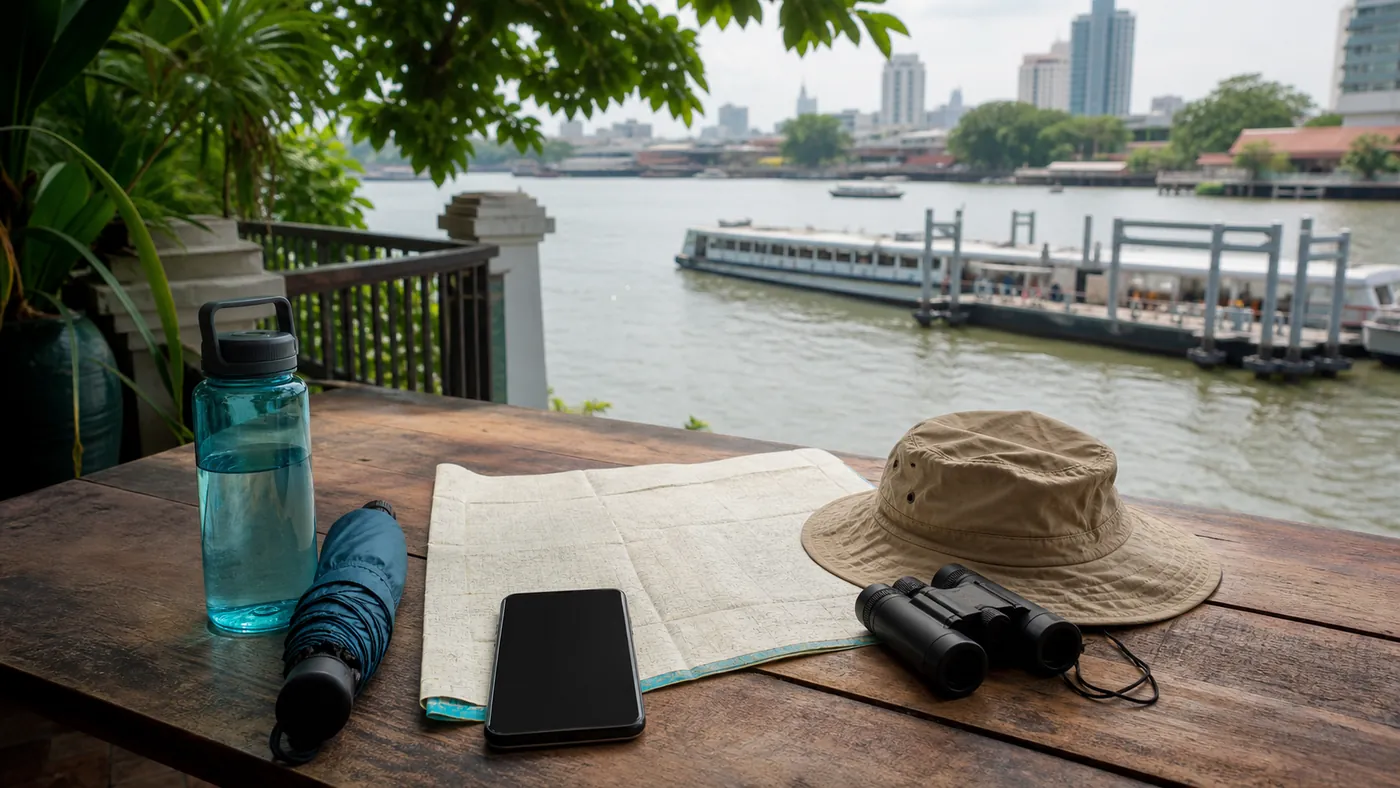
Before leaving, save the address of your chosen riverfront area and a nearby land-transport point. Carry enough water for the wait, sun and rain protection, and only equipment you can manage in a crowd. A small pair of binoculars may be more useful than positioning yourself at the edge of a congested walkway. If access changes, accept the wider view rather than chasing the procession from pier to pier.
For travelers using a private vehicle beyond central Bangkok, Thailand trip-planning and destination logistics may help with the journey around the city, but it should not be treated as an event-access authority. The deciding information remains the current official river and spectator notice.
How to watch with cultural attention
The procession brings together Buddhist observance, royal protocol, naval practice and highly skilled craftsmanship. Watching well begins with recognizing that context. Follow instructions from officials and venue staff, keep access lanes clear, avoid blocking residents or businesses, and use a quiet voice when the atmosphere calls for it. If a local rule conflicts with your preferred photograph or vantage point, the rule wins.
Clothing should be practical for Bangkok's heat and sudden rain while remaining appropriate for any temple or formal space you plan to enter. A riverbank viewing area is not automatically a temple visit, but an itinerary that includes Wat Arun or another religious site deserves more coverage than beachwear. Check each site's current visitor requirements rather than treating one general dress rule as universal.
Photography should document what you can see without turning other spectators, personnel or worshippers into props. Avoid intrusive close-ups, flash in sensitive settings and equipment that obstructs movement. Do not assume that elevated devices or special equipment are permitted simply because the river is visible; follow the restrictions posted for the site and day.
A verification-first checklist
- Choose the experience: minor rehearsal for date flexibility, full-dress rehearsal for the closest reported preview, or 6 November for the Royal Kathin Ceremony itself.
- Check the date twice: confirm it when booking and again within 24 hours of travel through the Royal Thai Navy, Marine Department or TAT.
- Start from land access: choose a reachable point within the announced corridor and a backup on the same bank.
- Assume river transport may pause: do not depend on a late ferry crossing without a same-day confirmation.
- Leave time: arrive well before the approximately 2:30 p.m. start and keep the afternoon flexible.
- Travel lightly: bring water, weather protection and compact viewing equipment without obstructing others.
- Respect the occasion: follow local instructions, protect access and remember that the ceremony's meaning comes before the photograph.
This method is also a useful editorial discipline. A culturally rich event can tempt destination publishers to lead with superlatives and borrowed imagery. Better travel storytelling as destination content strategy gives readers verified dates, explains what the occasion means, names uncertainty and helps them make a better decision. The same standard is explored in lessons from travel journalism about trust: distinguish what an authority has confirmed, what an independent publication has observed and what remains unknown.
The best plan leaves room for the river to change
The Royal Barge Procession offers an unusual way to see Bangkok's river as ceremonial route, working infrastructure and cultural memory at once. Its rarity rewards preparation, but preparation does not mean locking every detail. It means choosing the right date, understanding the significance, keeping a land route in reserve and rechecking the official plan.
Do that, and even a rehearsal becomes more than a distant line of boats. It becomes a view of the precision, patience and collective work required to carry a living tradition through a modern city—observed with enough care to let the occasion remain larger than the spectator.
Sources and References
- Tourism Authority of Thailand Newsroom: Thailand invites visitors to witness the Royal Barge Procession 2026 and rehearsals on Bangkok's Chao Phraya River (2026-08-14).
- Foreign Affairs Office, Government Public Relations Department: Watch Royal Barge Procession Rehearsals Ahead of 2026 Royal Kathin Ceremony (2026-08-07).
- Foreign Affairs Office, Government Public Relations Department: First Royal Barge River Rehearsal Set for August 17 (2026-08-14).
- Government Public Relations Department: Marine Department announces temporary navigation-control areas for 17, 20 and 27 August 2026 Royal Barge rehearsals (2026-08-17).
- Time Out Bangkok: Bangkok's Royal Barge Procession returns this November (2026-08-08).
FAQ
When is the Royal Barge Procession 2026 in Bangkok?
The Royal Barge Procession and Royal Kathin Ceremony are scheduled for Friday, 6 November 2026, at Wat Arun Ratchawararam. Reconfirm the date and access arrangements through current official notices before traveling.
What Royal Barge Procession rehearsals remain after 24 August?
Minor rehearsals are scheduled for 27 August; 3, 8, 17 and 23 September; and 2, 8 and 15 October. Full-dress rehearsals are scheduled for 21 and 28 October.
Where can the public watch the rehearsals?
Official announcements identify viewing areas along both banks of the Chao Phraya between Krung Thon Bridge and Wat Arun. Individual sites may still have their own access limits, capacity and operating rules.
Will Chao Phraya ferries run during rehearsals?
Do not assume normal service. The August rehearsal notice included temporary express-boat, electric-boat and cross-river ferry changes. Controls for later dates may differ, so verify the latest Marine Department information.
Is a full-dress rehearsal better than the main procession?
They serve different purposes. A full-dress rehearsal may offer a close preview with more flexibility, while the 6 November procession is part of the Royal Kathin Ceremony and carries distinct royal and religious significance.